From shapes to shades
Our approach is inspired by the fundamental principle: as light rays travel from a source to a surface, they can be obstructed at countless points within the space in between to generate the same shadow pattern. This boundless "design space" for crafting shadows has inspired us to explore new ways of introducing surfaces or perforated elements between the light source and the target surface, effectively transforming physical shapes into projected shades. While one objective is to display intricate and accurate shadow patterns, we are equally committed to ensuring that the shadow-casting structures themselves remain visually appealing when viewed in daylight.
Our shadow displays use one of the oldest principles there is: light meeting shape and creating shadow.
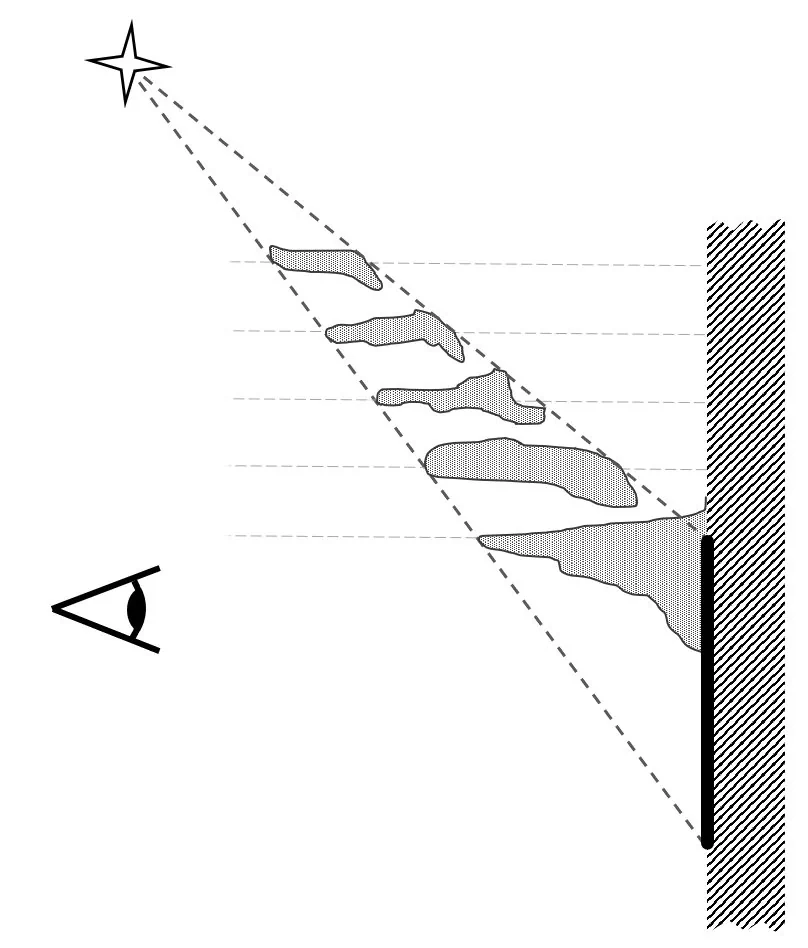
It is the same simple phenomenon people have seen for thousands of years in sunlight, firelight, and everyday objects. What is new is how we shape this principle to create something unexpected.
At the same time, the structures can be designed to be durable and practical. They can be produced for indoor or outdoor use, withstand harsh conditions, and remain effective for years. We have developed several design variants that can be adapted to different scales and applications.
Easy tiling and scaling
Patterns can be partitioned into an arbitrary number of tiles, consisting of a support grid attached to shadow-casting structures. The support grid on one hand serves as a rigid connecting structure. On the other hand, it acts as an alignment aid to attach one tile to the other in a spatially accurate manner.
Multiple lights
Shadow patterns can be split up arbitrarily into individual segments, each affected by a dedicated light source. This allows to create complex gradually emerging or disappearing shadow patterns. This technique enables the dynamic manipulation of shadows, making it ideal for applications that require sequential storytelling or gradual transitions.
Arbitrary curved surfaces
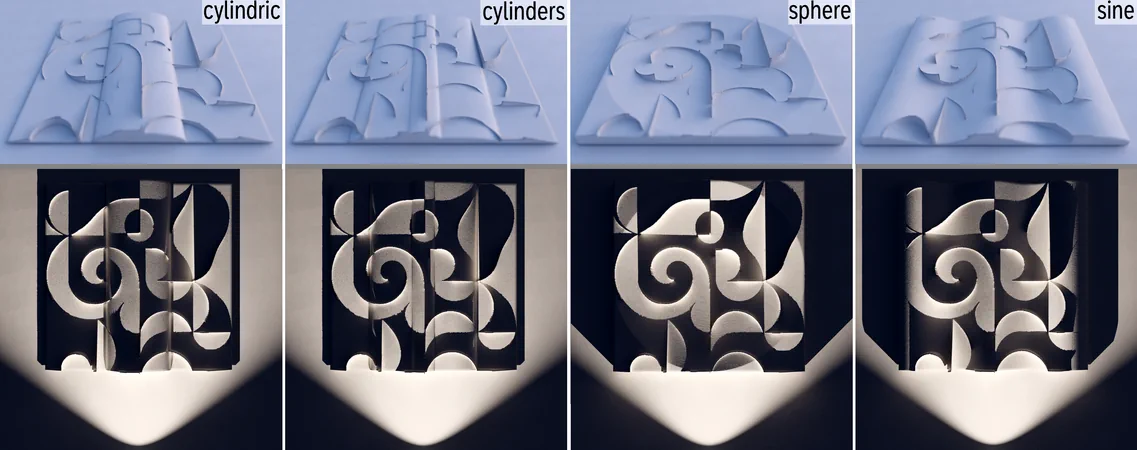
The base surface can be tailored to a required shape, including cylindrical or other complex facades. Shadows remain undistorted despite the curvature, enabling shadow displays on curved walls, columns, and even sculptural forms.
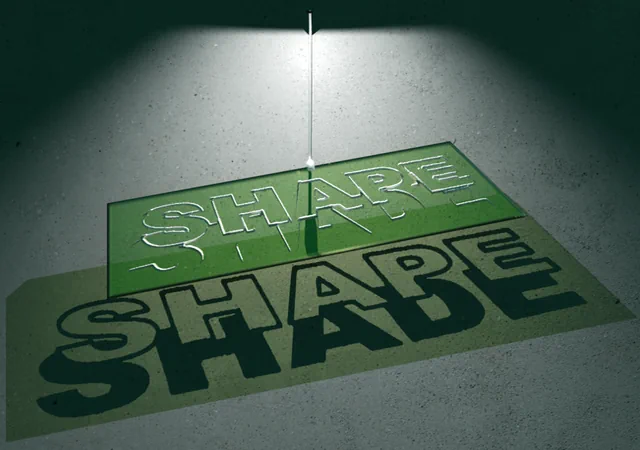
Projected shadows
When shadow-casting structures are placed on a transparent base, such as glass or plexiglass, the resulting shadow pattern can be projected onto a surface at some distance. This technique facilitates the creation of window-mounted or freestanding shadow displays, enabling novel use-cases.